
Many users can be associated with improvement in an organisation and it’s important for leads and sponsors to be fully aware of everyone’s roles.
Team improvement roles include:
- Allocated roles: Typically business sponsor, leads, admin and members. These roles are defined by Super Admin during set-up and deployment and each team can attribute these roles to any user in their organization
- Initiative owners: Responsible for actually implementing the initiative
- Gate approvers: Defined by team and by gate (e.g., Finance are expected to validate expected impact savings both during planning and also actual impact achieved at ‘lock-in’)
Team leads (requires ‘Lead’ authority level) define the roles for everyone in the team – either simply giving them access to the team’s pages as a team member or giving them sponsor, lead or admin roles:
- Team Sponsor: Access to team pages and can access team admin pages
- Team Admin: Access to team pages and can access team admin pages
- Team Lead: Access to team pages and can access team admin pages
- Team Member: Access to team pages
To define a team member’s role:
- Select the ‘Admin/Team Admin’ section from the ‘Admin’ dropdown list in the top navigation bar
- Select the ‘Team Roles’ menu option on the left hand side
- Select the user (from the list of all users)
- Select ‘Create team role’ button
- Complete ‘Create team role’ form
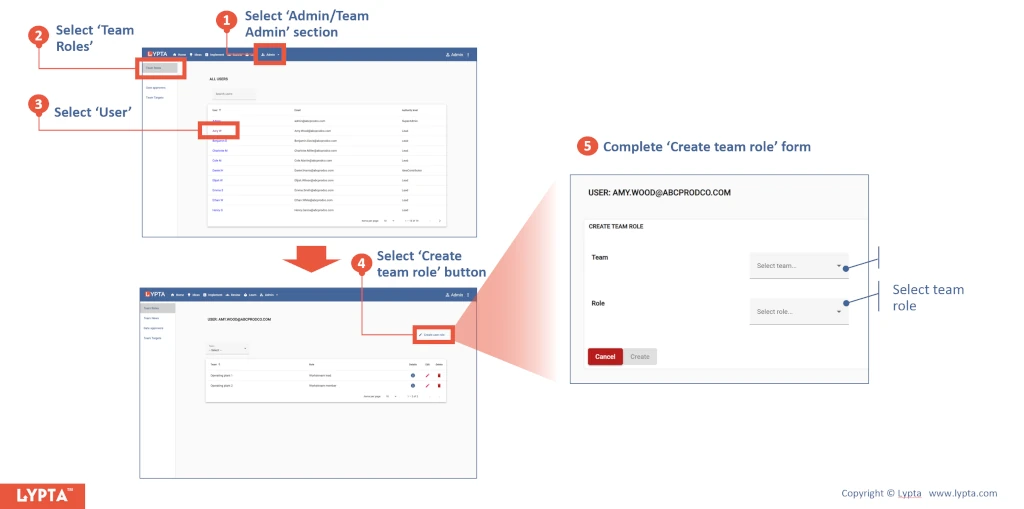
Once the role who has been created for the user, they will be able to see all the team’s pages. As a team lead you can edit (or delete) the role at any time.
Additionally, all users associated with a team (work org or program/workstream) can be easily viewed by selecting ‘People’ and then selecting one of the following options:
- All: Select any of the visible teams to see a full list of all users associated with the team and their allocated roles e.g., member, lead, admin, sponsor
- Initiative owners: A full list of all current initiative owners for the selected team
- Gate approvers: A full list of gate approvers by gate for the selected team
- Roles: Searchable list of all users by role
Continuous Improvement – typical roles
Typical team roles in Continuous Improvement include:
- Sponsor (or business owner): Recognised business owner/line leader for the org area. Accountable for the success of the improvement effort in their business area and who ‘owns’ success for the impacted area. The sponsor is able/willing to provide resources for the improvement effort, accept the potential business risks for the impacted area, provide direction to the improvement team and resolve roadblocks, escalations and issues as needed during implementation
- Lead: This role is optional in Continuous Improvement and is either undertaken by the Sponsor/Line Leader or, if resources are available, be split out as a separate resource. The Lead is responsible for driving the improvement processes leading to a successful outcome including setting up progress reviews, reporting on progress/roadblocks, providing training to the team’s initiative owners, sending out communications to all stakeholders on progress, supporting initiative owners through out all stages including implementation
- Team member: Initiative owners or team members who simply need access. Initiative owners are accountable and responsible for driving initiative progress including moving the initiative through the stage gates and likely the main ‘doer’ for the initiative. Whilst some of the initiative’s tasks may involve other individuals, the initiative owner is likely to be responsible for many of the tasks. Ideally, the initiative owner is sufficiently empowered in the organisation to be able to make the decisions needed themselves and also sufficiently close to the problem/issue the initiative is addressing that they are also the person who knows most and can also take direct action as needed
- Gate approvers: Make the decision at each gate as to whether the initiative should proceed to the next stage. Different gate approvers can be selected for different gates. For example, Finance needs to be closely involved prior to implementing to check that the costs and benefits estimates are correct and also at the end of implementation to track the actual costs and benefits achieved. Sponsors need to give approval prior to implementation to ensure that the business has accepted the costs, resourcing needed and potential risks before implementing
Program Transformation – typical roles
Typical transformation roles for the overall program include:
- Program sponsor: Recognised business owner/leader(s) for the program. Ultimately accountable for the success of the program and driving the required business outcomes for the program
- Program lead: Responsible for driving the program processes leading to a successful business outcome. The program lead ensures program processes are working in each workstream (including sufficient resourcing in place), tracks and reports on overall program progress and escalates issues to the program sponsor, ensures program communications are being sent out and finally, that training is deployed as needed
- Program member: Team members and analysts who provide support services to the overall program. This might also include HR resources (providing advisory, redeployment and training services) and Communications specialists. Super Admin can choose to set these up as additional roles if needed to give further structure to the improvement effort or simply allocate to ‘Program member’
Typical roles in the each Workstream include:
- Workstream sponsor (or business owner): Recognised business owner/leader(s) for the workstream. Accountable for the success of the program in their business area and who ‘owns’ success for the impacted area. The workstream sponsor is able/willing to provide workstream resources for the overall program (both workstream leads and initiative owners), accept the potential business risks for the impacted area, provide direction to the workstream and resolve roadblocks, escalations and issues as needed during implementation
- Workstream lead: Responsible for driving the workstream processes leading to a successful outcome including setting up progress reviews, reporting on progress/roadblocks, providing training to workstream initiative owners, sending out communications to all stakeholders on progress, supporting initiative owners through out all stages including implementation
- Workstream member: Initiative owners or team members who simply need access. Initiative owners are accountable and responsible for driving initiative progress including moving the initiative through the stage gates and likely the main ‘doer’ for the initiative. Whilst some of the initiative’s tasks may involve other individuals, the initiative owner is likely to be responsible for many of the tasks. Ideally, the initiative owner is sufficiently empowered in the organisation to be able to make the decisions needed themselves and also sufficiently close to the problem/issue the initiative is addressing that they are also the person who knows most and can also take direct action as needed
- Workstream gate approvers: Make the decision at each gate as to whether the initiative should proceed to the next stage. Different gate approvers can be selected for different gates. For example, Finance needs to be closely involved prior to implementing to check that the costs and benefits estimates are correct and also at the end of implementation to track the actual costs and benefits achieved. Workstream sponsors need to give approval prior to implementation to ensure that the business has accepted the costs, resourcing needed and potential risks before implementing