
The Improvement Program can be organised in one of two different underlying org structures:
- Current org structure: Used for Continuous Improvement where each team reflects the organization’s underlying org structure (e.g., Company/Division/Site/Dept) and where the improvement effort is being managed by the organization purely ‘in the line’ and each line leader is managing and driving all improvement
- Transformation programs/workstreams: Used for large transformation programs where additional resources are used to manage the change effort. Whilst the change is ‘driven’ by the line, the change is supported and managed by a program manager and supporting Program Management Office (PMO). The Transformation program has multiple workstreams with each workstream usually embedded in a business area and a workstream lead working closely with the line leader (=business owner) in that business area acting as a ‘sponsor’
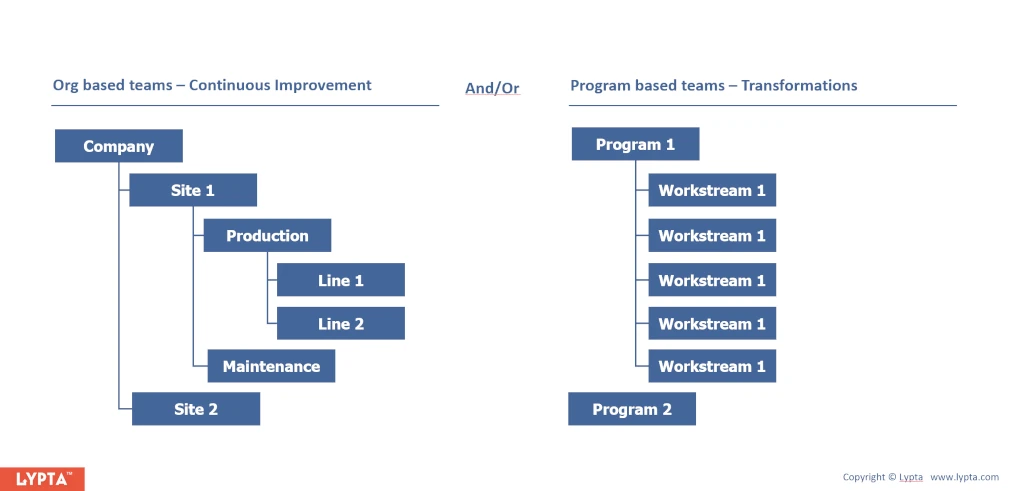
All initiatives in the Lypta system belong to teams in one of these org structures (defined during initiative creation) – giving the Lypta system the capability of managing both Continuous Improvement and major transformation change programs.
Throughout all Lypta documentation, team is used to mean an organization unit where improvement is being made and can be either part of Continuous Improvement or a large Transformation Program.
Org based team structure
Teams simply reflect the organization’s existing org structure hierarchy (e.g., Company/Division/Site/Dept).
Improvement effort is both managed and driven in the line with each line leader driving improvement effort in their own area. In this instance the line leader is running regular progress reviews themselves to drive the improvement (manage escalations, resolve roadblocks, provide direction).
This structure is ideal for Continuous Improvement where initiatives are continuously added to the improvement pipeline and no ‘program’ is being used to drive improvement.
Whilst outside departments might be involved (e.g., Continuous Improvement, Business Improvement or Business Excellence), these departments are for support and expertise only.
Transformation program team structure
Typically, a transformation program consists of workstreams delivering impact in multiple business areas. For example, a large transformation might have 10-15 workstreams depending on program size and complexity and typically covering:
- Operational areas (e.g., Plant 1, Plant 2,…)
- Functional areas (e.g., Procurement, HR, Legal, Finance) depending on program scope and the organisation structure
Each workstream:
- Has a workstream sponsor and the overall program has a program sponsor. Sponsors, both at program and workstream level, are accountable for achieving the required business outcome. Sponsors drive the improvement effort with support from the workstream lead (to manage escalations, resolve roadblocks and provide direction)
- Has a Lead who is responsible for supporting the workstream sponsor and helping drive the workstream processes leading to a successful outcome including setting up progress reviews, reporting on progress/roadblocks, providing training to workstream initiative owners, sending out communications to all stakeholders on progress, supporting initiative owners through out all stages including implementation
- Runs progress reviews independently with progress reviewed, escalations resolved and direction given as needed. Workstreams enable the change program to have strong focus at the workstream level within a specific part of the business
Workstreams enable improvement teams to manage progress in a targeted area of the business. A workstream may be aligned to specific line/organisational areas (e.g., Plant 1) or be cross-cutting based on impact across the organisation (e.g., Procurement, HR/People).
Workstreams can be organised on a flat structure or hierarchical basis using sub-workstreams allowing for even greater governance and reporting resolution.