
Impacts vs KPIs
Initiative and overall improvement program output is defined by ‘impacts’. The impacts across all initiatives should deliver the overall expected impact target for the improvement program in order for the program to meet its objectives. Impacts are are often confused with KPIs but are quite different.
Impacts:
- An output/lagging metric – measuring the initiative’s impact on the business and if successfully makes the required business change e.g., opex improvement
- Tied to the improvement program’s overall objectives
- Collectively, the impact across all the program initiatives should deliver the program’s overall target improvement e.g., opex savings
KPIs:
- Input/leading metrics that indicate if initiative is successful, or not, based on target performance
- Includes ‘Process’ KPIs based on physical processes that are being changed by the initiative (e.g., Task completion time) and ‘Risks’ KPIs used to ensure that the initiative is not adversely impacting the process e.g., Quality, Service Levels
- Specific to an initiative
Impacts are defined by:
- Impact centers and impact elements (and impact metrics)
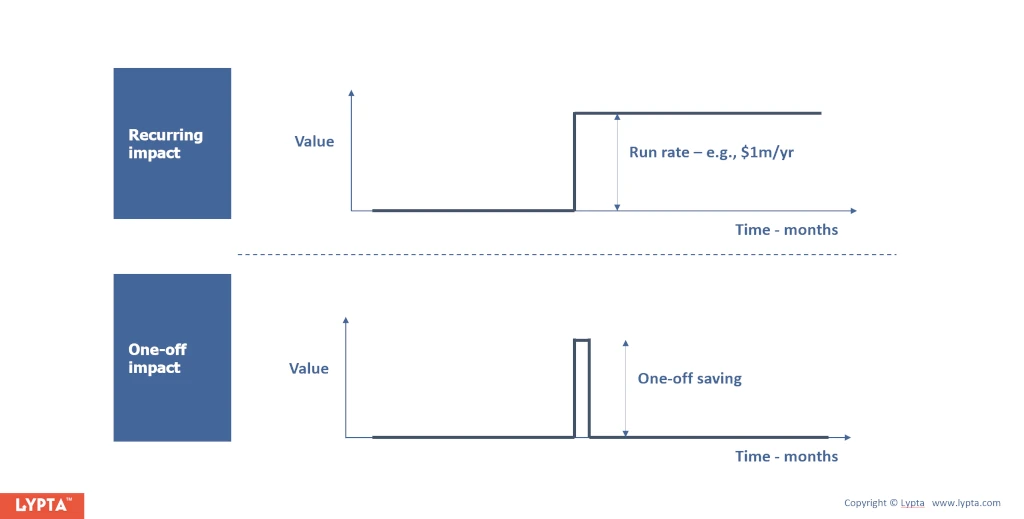
- Impact type (recurring vs one-off)
- Impact value (Plan, Forecast and Actual) and expected delivery date for the defined impact
1. Impact centers and impact elements
Each impact is defined by:
- Impact center: Impact centers represent a hierarchy of organization units in the organization. These are are defined by your organization’s Super Admin and reflect your organization’s org structure e.g.,, Company/Division/Site/Department etc
- Impact element: Impact elements represent a hierarchy of line elements and, if financial, they usually reflect your organization’s accounting system e.g., Opex/Labor/Payroll etc This is also defined by your Super Admin and as detailed as needed. Impact elements can also be non-financial and reflect physical metrics or frameworks e.g., OEE/Availability/Unplanned downtime/Equipment breakdown
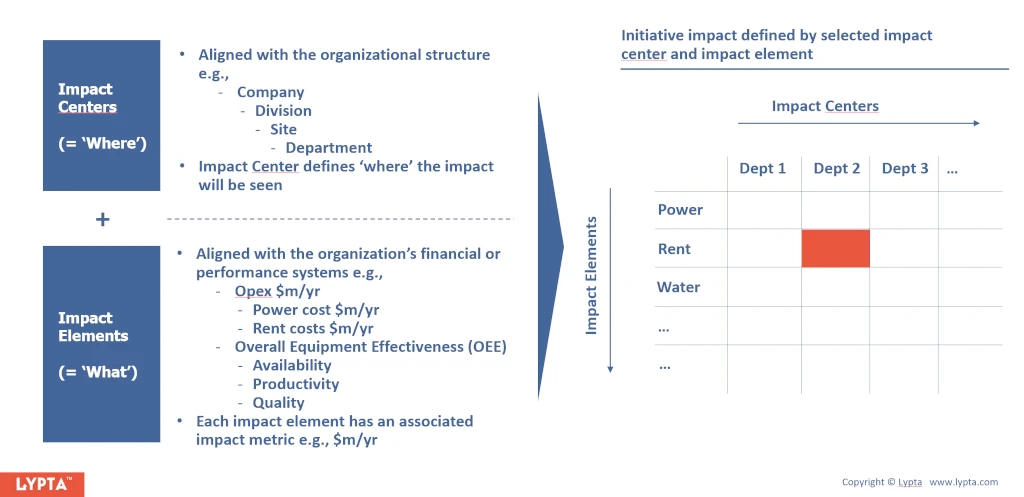
Each impact element also has an ‘impact metric’ which defines the units of the impact element e.g., $ or availability %.
Note: the impact element can be common across multiple impact elements e.g., power costs and rent costs might both be measured in units of $/m.
Impact types
Impacts are categorised as either recurring each year or one-off:
Impact value
Initiative value can be defined by as many impact values as needed e.g., opex and availability depending on what initiative value is being delivered.
- Value: Defined by the plan, forecast and actual values. In the early initiative stages prior to the implementation gate, only plan values are defined. Once the initiative is in implementation, the plan values are ‘frozen’ and the forecast and actual values then defined by the initiative owner
- Date: When the initiative is expected to start delivering value. Note: this is different from the ‘locked-in’ gate date and it is expected that initiatives will be tracked from some time (e.g., 3 months) from when the initiative is initially delivering value to when the initiative is ‘locked-in’; this then allows stakeholders to have some confidence that the initiative is able to sustain value consistently. A ‘delivering’ gate is often used to define when the initiative is expected to start delivering value.