
Ideally, the output of an idea session is a set of prioritized ideas that are then actioned. Prioritization is based on value and ease. A value-ease chart maps all the ideas to a single chart on the basis of each idea’s value (vertical axis) and ease (horizontal axis) and makes the prioritization easier:
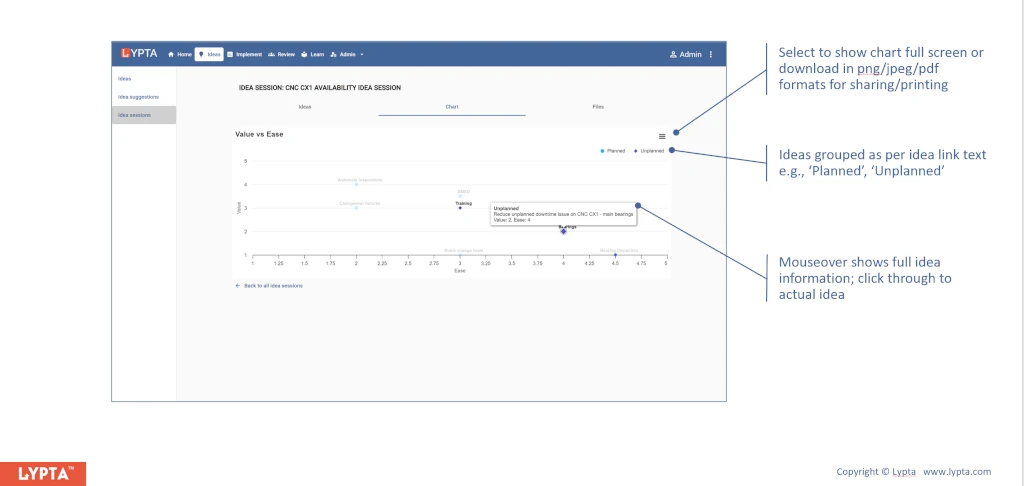
High value, high ease ideas are identified in the top right quadrant of the chart and these ideas should be actioned first.
A group discussion is used to attribute value-ease scores to each idea generated in the idea session and allows the group to score the ideas relative to each other.
Value-ease scores are subjective and very dependent both on the situation:
- Value: How much the idea is ‘worth’. Value is subjective and dependent on the situation. A scale of 1 to 5 is typically used where 1 is the lowest value and 5 is the highest value
- Ease: How easy it is to implement the idea. Again, this is subjective and dependent on the situation. Similar to ‘value’, a scale of 1 to 5 is typically used where 1 is very low ‘ease’ of implementation and 5 is easiest to implement. It’s useful to think about three criteria when evaluating ‘ease’:
1. Time to implement: 1-3 months = easy; 3-6 months medium; 6+ months hard
2. Capex/engineering: No capex/engineering needed = easy; significant capex/engineering needed = hard
3. New resources needed: No additional resources needed = easy; additional resources requiring recruiting/hiring = hard
To make the visualization easier, ideas can be given shortened abbreviations and also allocated to groups making the chart much easier to read.